Transport Overview
Japan's public transport network is legendary for good reason. Trains arrive on time (the average annual delay for Shinkansen is under 1 minute), stations are spotlessly clean, and the network reaches virtually every corner of the country. Here is what you need to understand about the main transport options available.
For an overview of how transport fits into your total trip budget, check our cost guide. If this is your first time in Japan, start with our Complete Japan Travel Guide for the big picture.
IC Cards: Suica & Pasmo
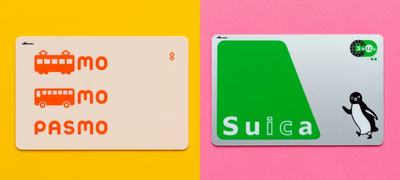
An IC card is the single most important thing to get when you land in Japan. It is a rechargeable smart card that works across all public transport (trains, subways, buses) in every major city. You just tap in and tap out. No need to figure out ticket prices or fumble with ticket machines.
Beyond transport, IC cards work at convenience stores, vending machines, coin lockers, and many restaurants. Think of it as your daily wallet in Japan.
Due to a global chip shortage, physical Suica and Pasmo cards are limited at some stations. If you cannot get a physical card, use the mobile version on your smartphone (iPhone 8+ or Android with NFC). Alternatively, the "Welcome Suica" tourist card is usually available at Narita and Haneda airports.
For the complete walkthrough including where to buy, how to charge, and mobile setup, read our How to Use Suica & Pasmo Cards guide.
Shinkansen: Bullet Trains
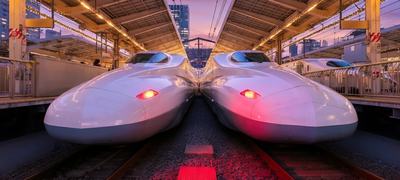
The Shinkansen is Japan's crown jewel of engineering. These bullet trains hit speeds of up to 320 km/h and connect major cities with military precision. Tokyo to Kyoto takes just 2 hours 15 minutes, Tokyo to Hiroshima about 4 hours. For a deep dive into seat types, booking, and routes, see our complete Shinkansen guide.
There are three seat classes: unreserved (自由席), reserved (指定席), and Green Car (グリーン車, equivalent to first class). For popular routes during peak times, reserved seats are strongly recommended.
The Nozomi is the fastest service (fewer stops) but is NOT covered by the JR Pass. If you have a JR Pass, take the Hikari, which is only 15–20 minutes slower on the Tokyo-Kyoto route. Without a JR Pass, book a Nozomi for the fastest journey.
Don't miss the ekiben tradition: buying a beautifully packed station lunch box to eat on the Shinkansen. It is one of the best regional food experiences in Japan.
Japan Rail Pass: Worth It?
The JR Pass gives you unlimited rides on JR trains nationwide, including most Shinkansen (except Nozomi and Mizuho). After the October 2023 price increase, it is a bigger investment, so you really need to do the math for your specific itinerary. Our complete JR Pass guide breaks down every scenario.
When the JR Pass IS Worth It
If you are doing a classic multi-city route like Tokyo → Kyoto → Hiroshima → Osaka, the individual Shinkansen tickets would cost roughly ¥40,000–50,000, making the 7-day pass break-even or a slight saving, plus all your local JR rides are free on top.
When the JR Pass is NOT Worth It
If you are only doing a Tokyo ↔ Kyoto round trip (¥27,000), staying in one city, or traveling mostly by local metro, you will lose money on the pass. Consider regional passes instead, as they are cheaper and cover specific areas.
Not sure? Enter your exact cities into our JR Pass Calculator. It compares the cost of individual tickets vs. the pass and tells you exactly how much you save (or lose). Takes 30 seconds.
City Metros & Subways
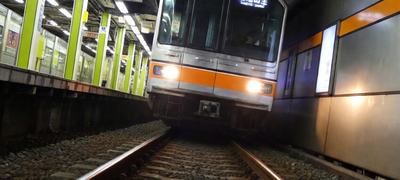
Tokyo alone has 13 subway lines, 30+ JR lines, and dozens of private railway lines. It sounds insane, but it is actually easy to navigate because Google Maps handles all of it. Your IC card works on everything. The only thing you need to understand is that different companies run different lines, which is why a single journey might show up as two charges. For a full navigation walkthrough, see our Tokyo Metro guide.
Other cities are simpler: Osaka has 9 metro lines, Kyoto has 2 subway lines plus buses, and most smaller cities are easily walkable with occasional train rides.
Airport Transfers
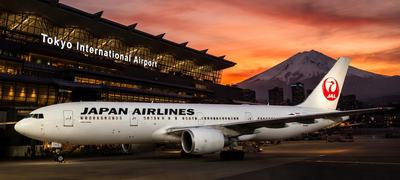
Most international flights arrive at Narita (NRT) or Haneda (HND) in Tokyo, or Kansai (KIX) near Osaka. Getting to the city center is straightforward but options vary wildly in price and time. For the complete breakdown of all airports, see our Airport to City guide.
Navigation Apps
You only need one app: Google Maps. It covers every train line, bus route, and walking direction in Japan with real-time accuracy. It even shows platform numbers and which car to board for the quickest exit.
For backup, Navitime is popular locally and sometimes shows cheaper route options. Japan Travel by Navitime is a free English version specifically designed for tourists. See our Transit Apps guide for setup instructions and tips. For other useful apps beyond transit, check Japan Travel Apps You Actually Need.
Before your trip, download offline maps for Tokyo, Kyoto, and Osaka in Google Maps. They work without data, a lifesaver if your eSIM has issues or you are in a subway station without signal.
Highway & Local Buses
Highway buses are Japan's budget secret. A night bus from Tokyo to Osaka costs ¥3,500–6,000 vs. ¥13,870 for the Shinkansen, and you save on a hotel night. Companies like Willer Express offer surprisingly comfortable seats with privacy hoods and outlets. For all the details, see our Japan Bus Guide.
Local buses are essential in cities like Kyoto (where many temples are not near train stations) and rural areas. Your IC card works on most city buses. Enter from the back, exit from the front, and tap your card on the reader when getting off.
For longer distances where even buses are too slow, domestic flights can sometimes beat trains, especially to Hokkaido, Kyushu, and Okinawa. And for rural exploration, consider renting a car.
Useful Transport Phrases
While most station signage has English, these phrases will help in situations where you need to ask for help, especially at smaller stations and bus stops. For the full list, visit our Train & Direction Phrases page.
Train Etiquette
Japanese trains are a shared space governed by mutual respect. The rules are not posted but everyone follows them, and breaking them will get you quiet but unmistakable disapproval. For the full guide with rush hour tips, read our Train Etiquette article. Also see our broader Culture & Etiquette Guide for other important rules.
Bullet trains are the one place where eating is encouraged. Buying an ekiben (駅弁, station lunch box) is a beloved tradition. Try regional specialties at each station. It is one of the best food experiences in Japan. However, strong-smelling food is frowned upon. Quiet conversation is fine, phone calls are not.
Frequently Asked Questions
Common transport questions from visitors
Printable packing checklist + 50 essential phrases PDF — plus weekly tips in your inbox.